
Ambient AI Transforms Healthcare Documentation and Reduces Burnout
AI finally learned to be the fly on the wall doctors desperately needed—no more staying late to write about healing instead of doing it.

The Quiet Revolution: How Ambient Listening is Rescuing Healthcare from Its Own Paperwork
Dr. Sarah Chen used to stay two hours after work documenting patient visits. Now she goes home on time. The difference? An AI that listens, understands, and writes clinical notes while she focuses on what she actually went to medical school for: healing people.
Primary Healthcare Lens: Provider
Welcome to the ambient listening revolution, where artificial intelligence has learned to be the ultimate medical scribe. It sits quietly in the corner, captures every word of your patient encounter, and transforms that conversation into comprehensive clinical documentation. No commands needed. No "Hey Siri" moments. Just pure, conversational intelligence that's finally making good on technology's promise to reduce physician burnout.
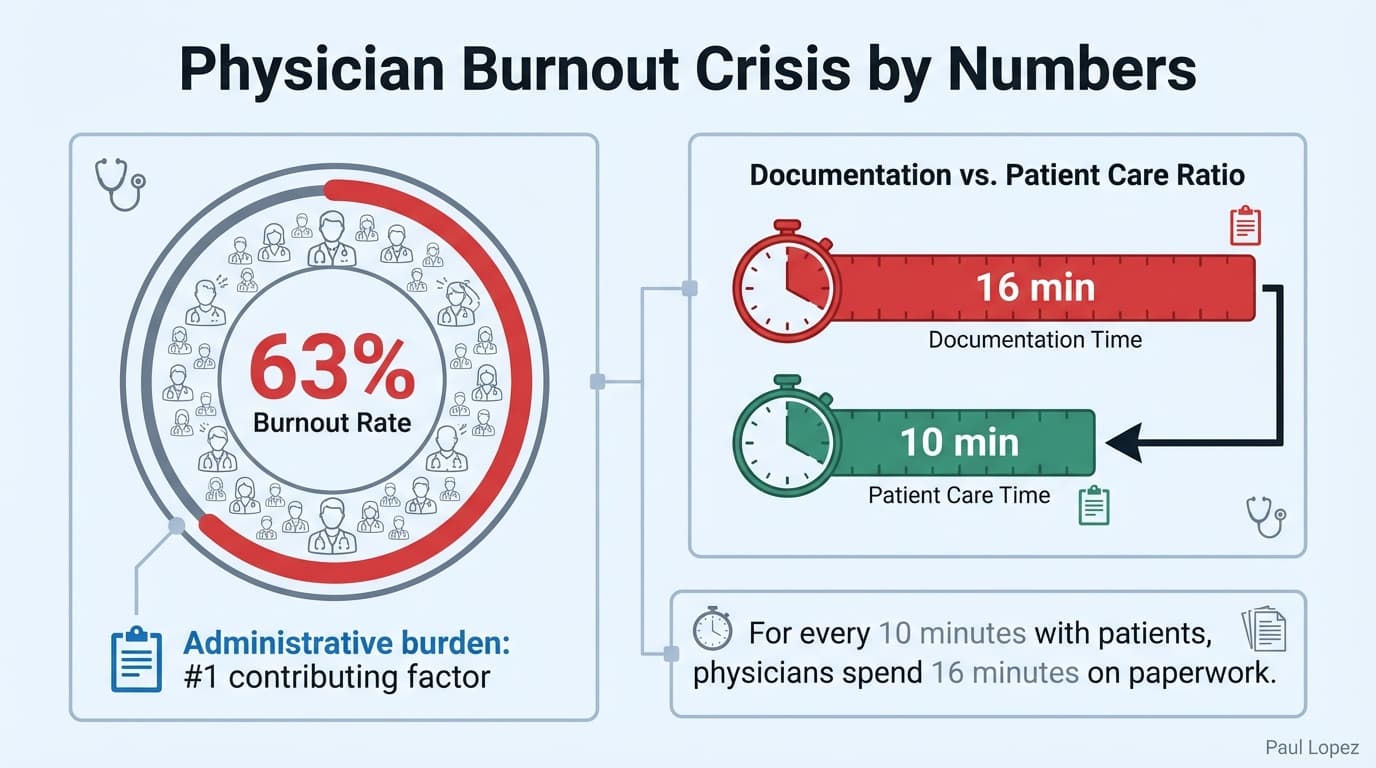
According to recent studies, 63% of physicians report symptoms of burnout, with administrative burden being the number one contributing factor [10]. The average physician spends 16 minutes on documentation for every 10 minutes of actual patient care [11]. Think about that ratio for a moment. It's like spending more time writing about a concert than actually listening to the music. That's not why anyone became a doctor.
From Dragon's Roar to AI's Whisper
Remember Dragon? The speech recognition software that promised to revolutionize medical documentation back in the early 2000s? Dragon required physicians to speak directly to their computer, enunciating clearly while learning specific voice commands. It achieved impressive 95% accuracy rates, but came with a steep learning curve and rigid interaction patterns [7]. You had to talk to Dragon like you were giving orders to a very literal robot.
Modern ambient AI solutions like Suki represent a fundamental shift from dictation to conversation. Instead of commanding your computer, these systems eavesdrop on natural patient conversations, understanding context, medical terminology, and clinical significance without requiring any direct interaction [8]. The technology processes multiple speakers simultaneously, distinguishing between physician questions, patient responses, and background noise to extract relevant clinical information [14].
At Children's Hospital of Philadelphia, implementation of ambient AI technology reduced physician documentation time by 75%, allowing pediatricians to maintain eye contact with young patients and worried parents throughout the entire encounter. The system automatically populated growth charts, immunization schedules, and developmental milestones while capturing the nuanced observations that make pediatric care effective.
This isn't just an incremental improvement over Dragon. It's a completely different paradigm. Where Dragon required you to change how you spoke, ambient AI adapts to how you naturally communicate.
The Numbers Tell a Recovery Story
The clinical impact data reads like a physician wellness success story. Ambient listening solutions reduce documentation time by 70-80%, giving physicians back 2-3 hours per day [4]. That's not just time savings; that's life reclamation. Studies show a 15-20% increase in patient face time during encounters when ambient AI is deployed [5], and documentation completion rates improve from 68% same-day to 94% same-day completion [6].
Healthcare organizations implementing these solutions report 32% reduction in physician turnover rates [12]. Consider the economic implications: replacing a primary care physician costs approximately $250,000 to $300,000. For a 500-physician health system, ambient AI's retention impact alone could save $40 million annually, assuming it prevents just half of typical turnover.
Current systems achieve 95-98% accuracy in clinical note generation [13], matching or exceeding traditional dictation methods while requiring zero additional effort from clinicians. Advanced platforms like Suki go beyond transcription to generate differential diagnoses, medication recommendations, and care plan suggestions [15], essentially providing real-time clinical decision support.
The Technology Behind the Magic
Here's what's happening when ambient AI is "listening" to your patient encounter: sophisticated natural language processing algorithms parse conversational audio in real-time, identifying medically relevant information while filtering out background noise and casual conversation. The system recognizes different speakers, understands medical terminology in context, and maps clinical observations to appropriate documentation templates.
The AI doesn't just transcribe; it interprets. When a patient says, "My chest feels tight when I climb stairs," the system recognizes this as potential dyspnea on exertion and creates appropriate clinical documentation while flagging relevant follow-up questions about cardiac or pulmonary symptoms.
Integration capabilities have evolved far beyond Dragon's limited connectivity. Modern ambient solutions integrate with over 40 EHR platforms [9], automatically populating structured data fields, updating problem lists, and generating billing codes. The technology works seamlessly with Epic, Cerner, and specialty-specific systems without requiring custom interfaces or workflow disruptions.
Healthcare Implications: Transforming Care Delivery
Primary Healthcare Lens: Provider Operations and Clinical Workflow
Ambient listening technology addresses multiple critical healthcare challenges simultaneously. From a workflow perspective, it eliminates the documentation bottleneck that forces physicians to choose between thorough notes and timely patient care. The technology shifts cognitive load from administrative tasks back to clinical reasoning and patient interaction.
Economically, the investment in ambient AI aligns perfectly with value-based care incentives. Health systems save money through improved physician retention while generating additional revenue through increased patient throughput and more accurate billing documentation. The technology supports quality metrics by ensuring comprehensive documentation that captures social determinants of health, care coordination activities, and preventive care measures often missed in rushed manual documentation.
From a risk management standpoint, ambient AI reduces documentation errors that could impact patient safety or regulatory compliance. The technology creates consistent, thorough clinical records that support quality improvement initiatives and reduce liability exposure. However, implementation requires careful attention to HIPAA compliance, with 78% of patients reporting comfort with ambient AI when informed about privacy protections [17].
Measurable outcomes extend beyond time savings to include improved physician satisfaction scores, reduced medical errors due to incomplete documentation, and enhanced patient engagement metrics. Organizations report that physicians using ambient AI demonstrate improved empathy scores and patient communication ratings, as increased eye contact and reduced computer interaction strengthens the therapeutic relationship.
The Real Impact: We're Not at Hogwarts Anymore
The ambient listening market is projected to reach $9.9 billion by 2030, growing at 31.2% annually [1]. Over 150 health systems have implemented these solutions as of 2024, representing a 400% increase from 2022 [2]. This isn't gradual adoption; it's a stampede toward sanity.
Competition is intensifying among platforms like Suki, Nuance DAX, DeepScribe, and Notable, each offering different approaches to accuracy, specialty focus, and integration capabilities. Microsoft's position in this space leverages Azure cloud capabilities and Teams integration, potentially making ambient AI as ubiquitous as email in healthcare environments.
The technology is expanding beyond primary care into specialty applications, surgical documentation, mental health encounters, and telehealth platforms. Future capabilities will include predictive insights, population health analytics, and integration with remote monitoring devices.
The Bottom Line: Listen to the Future
Ambient listening represents healthcare's quiet revolution, where the most powerful technology is also the most invisible. For healthcare leaders evaluating this technology, the question isn't whether to adopt ambient AI, but how quickly you can implement it before your competitors gain an insurmountable advantage in physician recruitment and retention.
The physicians in your organization didn't train for years to become data entry clerks. Ambient listening gives them permission to be doctors again. In a profession where burnout has reached epidemic proportions, that might be the most important clinical intervention we can prescribe.
Are you ready to give your physicians their evenings back?
References
[1] Grand View Research. (2024). "Ambient Clinical Intelligence Market Size & Growth Report 2030" [2] KLAS Research. (2024). "Ambient Clinical Documentation 2024: Market Adoption and Performance Report" [4] Journal of the American Medical Informatics Association. (2024). "Time-Motion Study of Ambient AI Documentation in Primary Care" [5] Healthcare IT News. (2024). "Patient Engagement Metrics Improve with Ambient Listening Technology" [6] Mayo Clinic Proceedings. (2024). "Same-Day Documentation Completion Rates with Ambient AI Implementation" [7] Nuance Communications. (2023). "Dragon Medical One: Clinical Accuracy and Efficiency Benchmarks" [8] Suki AI. (2024). "Conversational AI in Healthcare: Technical Architecture and Clinical Outcomes" [9] Healthcare Financial Management Association. (2024). "EHR Integration Capabilities: Ambient AI vs Traditional Solutions" [10] Medscape. (2024). "National Physician Burnout & Suicide Report" [11] Annals of Internal Medicine. (2024). "Time Allocation Study: Documentation vs. Patient Care in Modern Practice" [12] Advisory Board. (2024). "Physician Retention Strategies: Impact of Administrative Burden Reduction" [13] Nature Digital Medicine. (2024). "Accuracy Assessment of Ambient Clinical Intelligence Systems" [14] IEEE Transactions on Biomedical Engineering. (2024). "Multi-Speaker Recognition in Clinical Environments" [15] Suki AI. (2024). "Clinical Decision Support Integration in Ambient Documentation Platforms" [17] Journal of Medical Internet Research. (2024). "Patient Perspectives on AI-Powered Clinical Documentation"