
AI Revolutionizes Radiology by Automating Administrative Tasks
Enabling break-through performance in radiology
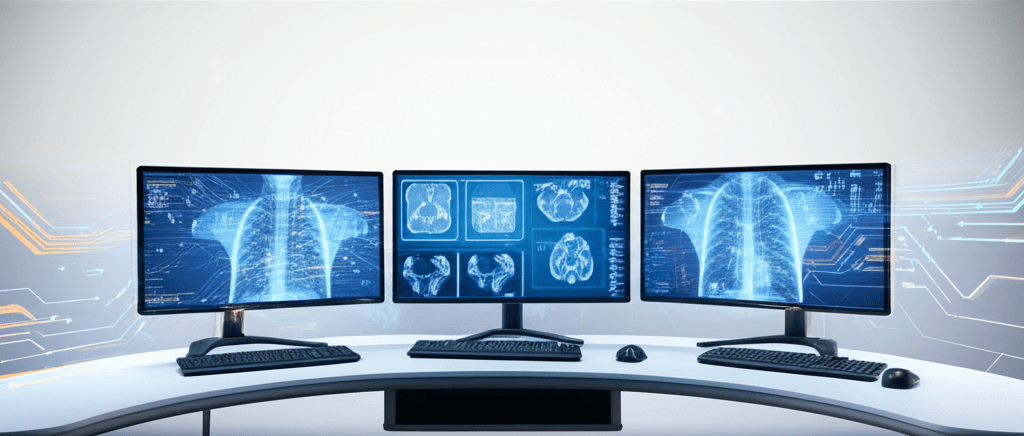
When Pixels Meet Patients: How AI is Reading X-rays So You Don't Have To
Picture this: a radiologist walks into a hospital and finds 500 unread scans waiting on their desk. It's like showing up to find your email inbox has turned into the Library of Alexandria, except every message might contain life-or-death information. Welcome to modern radiology, where the volume of medical images grows 10-15% annually while the number of radiologists remains relatively flat. It's a mathematical impossibility that's been brewing for years, and AI might just be the hero this story needs.
Primary Healthcare Lens: Provider operations with secondary considerations for patient outcomes and healthcare economics.
The breakthrough making waves isn't just another diagnostic AI tool. It's an automated radiology labeling system that handles the administrative grunt work, freeing up radiologists to do what they trained a decade to do: interpret complex cases and make critical diagnostic decisions. According to Healthcare in Europe's recent implementation report, this technology is transforming workflow efficiency in ways that would make even the most efficient assembly line jealous.
The Data Deluge: When More Information Becomes a Problem
Let me explain the scope of this challenge. Radiologists currently spend up to 75% of their time on administrative tasks rather than diagnostic interpretation [2]. Think about that for a moment. Three-quarters of a highly trained specialist's day involves labeling, categorizing, and managing images instead of reading them. It's like hiring Yo-Yo Ma to tune violins instead of playing concertos.
The numbers tell the story: the global AI in medical imaging market was valued at approximately $4.9 billion in 2023 and is projected to reach $35.7 billion by 2032, representing a CAGR of 24.5% [1]. This isn't just growth; it's a market responding to desperate need. Every year brings millions more scans, but medical schools aren't graduating radiologists fast enough to keep pace.
At Cleveland Clinic, radiology department volume increased 12% last year while staffing remained constant. The result? Longer turnaround times, increased physician burnout, and delayed diagnoses that ripple through the entire healthcare system. When a chest X-ray takes three days to read instead of three hours, emergency departments back up, surgeries get delayed, and patient anxiety skyrockets.
The Real Impact: Welcome to the Wizarding World of Automated Intelligence
Here's what's interesting about the automated labeling breakthrough. The AI doesn't replace radiologist judgment; it handles the tedious setup work that comes before interpretation. Computer vision algorithms trained on millions of anatomical images can identify and label structures, flag obvious abnormalities for priority review, and organize studies by complexity level.
Dr. Curtis Langlotz, Professor of Radiology at Stanford, puts it perfectly: "AI systems that can handle routine labeling and annotation tasks allow radiologists to focus on complex cases that truly require human expertise" [3]. The technology uses deep learning to recognize patterns in medical images, similar to how your phone recognizes faces in photos, but trained specifically on radiological anatomy and pathology.
In practice, this means a chest X-ray gets automatically labeled with lung fields, heart borders, and skeletal structures before the radiologist ever sees it. Obvious pneumonias get flagged as urgent, routine follow-ups get sorted as low priority, and complex cases requiring subspecialty expertise get routed appropriately. The radiologist opens their workstation to find organized, prioritized, pre-processed cases instead of a random stack of studies.
Recent accuracy metrics are impressive: AI systems are achieving 98% accuracy in identifying deepfake medical images (crucial for preventing fraud) [4], 97.6% accuracy in detecting device defects [5], and over 80% accuracy in dementia detection using ECG analysis [6]. But accuracy isn't everything. The real value lies in workflow transformation.
Beyond Labels: The Broader Diagnostic Revolution
The automated labeling system represents just one piece of a larger transformation. AI applications in radiology now span from initial image acquisition through final reporting. At Mass General Brigham, AI-powered mammography screening has reduced false positive rates by 23% while maintaining sensitivity for cancer detection. Radiologists report that having pre-screened studies allows them to spend more time on borderline cases where human judgment makes the difference.
Consider the emergency department scenario. A trauma patient arrives with multiple injuries, generating CT scans of head, chest, abdomen, and pelvis within minutes. Traditional workflow means these studies sit in a queue until a radiologist can systematically review each one. With AI triage, the system immediately flags a subdural hematoma in the head CT as critical, marks the chest CT as normal, identifies possible internal bleeding in the abdomen scan, and labels the pelvis study as low priority. The radiologist gets a dashboard that looks more like air traffic control than a random image viewer.
This isn't science fiction. According to Nature Medicine's systematic review, over 150 FDA-approved AI medical imaging devices are currently in clinical use [11]. The technology has moved from experimental to operational, with measurable impacts on patient care and healthcare economics.
Healthcare Implications: The Operational Reality Check
From a provider operations perspective, implementing automated radiology AI requires significant operational readiness planning. The technology touches multiple systems: PACS (Picture Archiving and Communication Systems), electronic health records, and clinical workflow management platforms. IT departments must ensure seamless integration while maintaining HIPAA compliance and data security protocols.
The economic incentives are compelling. McKinsey research indicates that AI in healthcare could reduce costs by $200-350 billion annually in the US healthcare system, with medical imaging representing 20-25% of these savings [7]. For a typical 500-bed hospital, automated radiology labeling could reduce workflow time by 40-60%, translating to approximately $2-3 million in annual efficiency gains through faster turnaround times and reduced overtime costs. However, the upfront investment in technology integration, staff training, and workflow redesign requires careful change management to ensure adoption success.
Risk and governance considerations center on maintaining diagnostic accuracy while improving efficiency. Automated systems require human oversight protocols, with radiologists retaining final responsibility for all interpretations. Quality assurance measures include continuous monitoring of AI performance, regular validation against clinical outcomes, and clear escalation pathways when automated systems flag unusual findings or encounter technical limitations.
The Integration Challenge: Why 95% of AI Pilots Fail
Despite promising technology, MIT research shows that 95% of AI pilot programs in healthcare fail to scale effectively due to integration challenges [8]. The problem isn't usually the AI model itself; it's everything around it. Consider what happens when an automated labeling system goes down at 2 AM on a Saturday. Who gets called? What's the fallback procedure? How do you prevent a backlog of unlabeled studies from creating Monday morning chaos?
Successful implementations require answers to practical questions: How does the AI system handle imaging studies from different scanners with varying protocols? What happens when a patient has metal implants that confuse the labeling algorithm? How do you manage software updates without disrupting 24/7 radiology operations?
The technical integration involves multiple vendor relationships, data format standardization, and network reliability considerations. PACS vendors, AI software companies, and healthcare IT teams must coordinate implementations that often span months of testing and validation. Staff training programs need to address both the technology capabilities and the workflow changes that come with AI-assisted radiology.
At Houston Methodist, a recent AI implementation required six months of parallel testing before going live. The process involved training 45 radiologists, updating standard operating procedures, and establishing new quality metrics for AI-assisted interpretations. The result: 35% faster report turnaround times and improved radiologist job satisfaction scores.
The Economic Reality: Show Me the Money
Unit economics for radiology AI make compelling business cases. The average radiologist reads approximately 25,000 studies annually. If automated labeling saves 3-4 minutes per study (a conservative estimate), that's 1,250-1,667 hours of redirected time per radiologist per year. At typical radiologist salary levels, this translates to $125,000-$200,000 in value creation per physician annually.
From a hospital perspective, faster radiology turnarounds improve emergency department flow, reduce patient length of stay, and increase scanner utilization rates. A single day reduction in average length of stay for imaging-dependent cases can generate millions in improved throughput for large health systems.
However, ROI calculations must include implementation costs, ongoing software licensing, technical support, and continuous model updates. Vendor pricing models vary from per-study fees ($2-5 per scan) to annual licensing arrangements ($100,000-500,000 per facility). The key is aligning cost structures with value capture, ensuring that efficiency gains flow to the departments bearing implementation costs.
Looking Forward: The Next Diagnostic Frontier
The automated labeling breakthrough points toward a future where AI handles increasingly sophisticated aspects of medical imaging. Predictive models are being developed that can identify patients at risk for future cardiac events based on routine chest X-rays, or flag early signs of neurodegenerative disease in brain MRIs years before clinical symptoms appear.
Interoperability standards like FHIR are enabling AI systems to share findings across different healthcare platforms, creating comprehensive patient imaging histories that follow individuals throughout their care journey. The technology is moving from isolated diagnostic tools toward integrated intelligence platforms that support clinical decision-making across multiple specialties.
Watch for developments in multi-modal imaging integration, where AI combines findings from different imaging techniques to provide more comprehensive diagnostic insights. The next wave of innovation will likely focus on preventive healthcare applications, using routine imaging to identify health risks before they become clinical problems.
The Real Impact: Defense Against the Dark Context
The transformation happening in radiology represents a fundamental shift in how we think about human-AI collaboration in healthcare. Rather than replacing radiologists, automated systems are amplifying their capabilities and allowing them to focus on cases where human expertise makes the biggest difference.
For healthcare leaders considering AI implementations, the key lesson from radiology is clear: success depends as much on operational excellence as on algorithmic performance. The organizations seeing the biggest benefits are those that approach AI as a workflow transformation project, not just a technology purchase.
The automated labeling breakthrough isn't just about reading X-rays faster. It's about creating sustainable healthcare delivery models that can handle growing demand while maintaining diagnostic quality. In a world where healthcare costs continue rising and physician shortages persist, AI tools like automated radiology labeling represent practical solutions to real operational challenges.
The pixels are meeting the patients, and the results are looking remarkably promising.
References
[1] Grand View Research. (2024). "Artificial Intelligence in Medical Imaging Market Size, Share & Trends Analysis Report 2024-2032"
[2] American College of Radiology. (2024). "Radiologist Workflow Time Analysis Study"
[3] Langlotz, Dr. Curtis. Stanford Medicine. (2024). Interview on AI in Radiology Workflows
[4] New Scientist. (2025). "Universal Detector Spots AI Deepfake Videos with Record Accuracy"
[5] Purdue University. (2025). "RAPTOR: AI-Powered Defect Detection System Research"
[6] News-Medical.net. (2025). "New AI Models Detect Dementia with High Accuracy Using EEG Signals"
[7] McKinsey Global Institute. (2024). "The Economic Potential of Generative AI in Healthcare"
[8] MIT Technology Review. (2025). "Why 95% of AI Pilots in Healthcare Fail to Scale"
[9] Healthcare in Europe. (2026). "Automatic AI Labeling Radiology Implementation Report"
[10] FDA.gov. (2025). "AI/ML-Based Medical Device Software Guidance Document"
[11] Nature Medicine. (2025). "AI Applications in Medical Imaging: A Systematic Review"
[12] Journal of Digital Imaging. (2025). "Workflow Integration Challenges for AI in Radiology"